


.avif)
“In essence, the rules governing crop protection in Europe and Africa are similar”
Maybritt Kiel is a lobbyist representing Royal FloraHolland and the Dutch Flower Auctions Association (VBN) in Brussels, where she advocates for the sector's interests within the European Union. Dirk Hogervorst is the CEO of EMF carnation farm, which operates in Ethiopia and Kenya. Together, they discuss a topic that is of concern to both of them: regulations relating to crop protection.

View article
.jpg)
the nursery of the future
What Ter Laak Orchios learnt from a phishing attack
Our sector is facing cyber incidents with increasing frequency. It's hardly a question of if you'll be affected, but when. For example, Ter Laak Orchios was hit by a phishing attack this spring, which, fortunately, was nipped in the bud fairly quickly.
View article

Agreed
Disagree
VOTING RESULTS FROM THE MEMBERS’ NEWSLETTER OF 24 JUNE 2026
The issue
Statement: "Sustainable investments only make sense if they also generate a financial return."
View article
.jpeg)
Members have their say
What innovations are ensuring your business is future-proof?
The world in which we grow is changing rapidly. Farming needs to become more sustainable and smarter. Staff in the Netherlands are in short supply and expensive. At the same time, consumers still expect a perfect product, preferably at a price that isn't too high. How do you keep your business profitable in that world? A conversation with three growers about a radical, unexpected or intriguing innovation at their farm: what does it take to make it work? How does it help? And: how do they see the future?
View article
.jpg)
Past / Present / Future
Entrepreneurship over the years
Angela Mutters-van der Maarel has been managing director at Maarel Orchids since 2024. She is now ensuring that the company can take the next step towards sustainability and good employment practices. It wasn't immediately clear that Angela would join the family business. Angela: "First, I wanted to discover for myself what the world had to offer. And my parents encouraged that, too. They said, ‘Choose something you enjoy. It doesn’t necessarily have to be in horticulture.'"
View article
.JPG)
sowing and harvesting
“We achieve a healthy and energetic working environment by working together”
Every year, Stigas presents the 'Vital and Healthy Working' award. In doing so, the prevention service for the agricultural and green sectors is highlighting good examples in this area. What can our members do to promote healthy and active working practices within their organisations?
View article
.png)
FLORATALK
The next step towards transparency on sustainability
For Royal FloraHolland (RFH), just as for its members and trading partners, our sector must demonstrate ever more clearly and transparently how flowers and plants have been grown by growers in a sustainable manner.
View article
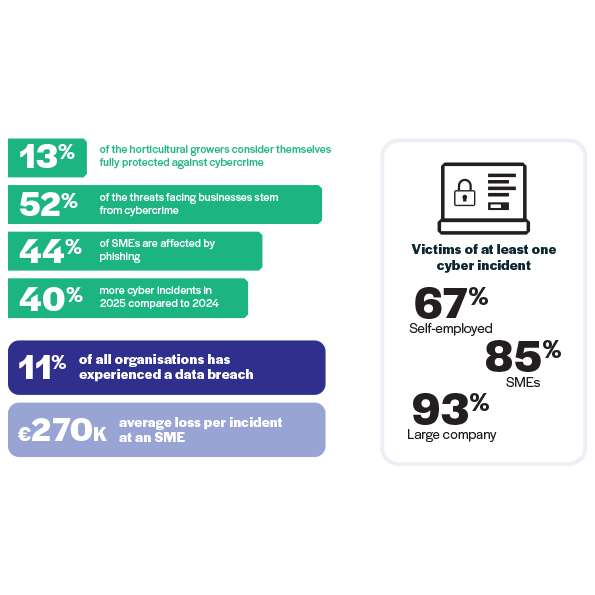
Cyber threats in figures
View article
%20(Aangepast).jpg)
CHAIRMAN SPEAKING
‘Be proud of what we achieve together’
As you read the Members’ Newspaper in front of you, I think we should be a little prouder of how much we have already achieved in terms of efficiency and sustainability.
View article
IN THE NEWS
Our cooperative in the news
View overview
CALENDAR
Upcoming events
View calendar
.jpg)
.jpg)