Members
have their say

What innovations are ensuring your business is future-proof?

The world in which we grow is changing rapidly. Farming needs to become more sustainable and smarter. Staff in the Netherlands are in short supply and expensive. At the same time, consumers still expect a perfect product, preferably at a price that isn't too high. How do you keep your business profitable in that world? A conversation with three growers about a radical, unexpected or intriguing innovation at their farm: what does it take to make it work? How does it help? And: how do they see the future?

MEMBER SPEAKING

Paul van Holstein

Holstein Flowers

Paul van Holstein is the commercial director and a third-generation member of the family-run business Holstein Flowers. As far as he is concerned, innovation is not a luxury, but an absolute must. Anyone who doesn't produce more efficiently will eventually come up short.

"As a company, we are always working on innovation. The reason is simple: in this rapidly changing market, you simply can't afford to stand still any longer. Working hard and putting in long hours – as my father and uncles always did – is no longer enough to keep the business afloat. You have to keep up with the times. Over the past year, we have shown that innovation is not always primarily about automation. Together with Royal FloraHolland and other growers, we developed the new reusable flower bucket, the Fc555.

We supply a large proportion of our flowers directly to the customer. The advantage is that this also means we get first-hand feedback. Customers were increasingly asking whether the packaging could be made more sustainable. The cardboard collars we used, in particular, were an eyesore. We then cut into the existing buckets. That's how we came up with the prototype for the Fc555. Together with the cooperative and our product group, we further developed the bucket. It later turned out that the bucket was also a solution for other growers. The Fc555 is now in widespread use.

And a nice bonus is that this simplified, standardised packaging makes it easier for us to automate the process.

If you walk in here in a few years' time, you'll see a flower factory: by then, the processing and handling will be fully automated. We're taking small steps towards that goal. We constantly monitor whether an innovation pays for itself. Gerbera cultivation will probably always require a relatively large number of workers. But automation also has a positive effect on those employees: it will hopefully lead to a calmer working environment and a lighter workload during peak periods.

With all this technology, you almost forget what really matters: our gerberas. We're innovating in that area too. Just take a look at our unique chocolate-coloured gerbera, Chocoloco. It just suddenly turned up amongst our other varieties. This is in keeping with our company's origins, where we developed our unique range through our own breeding programme. Well, nature never ceases to surprise you."
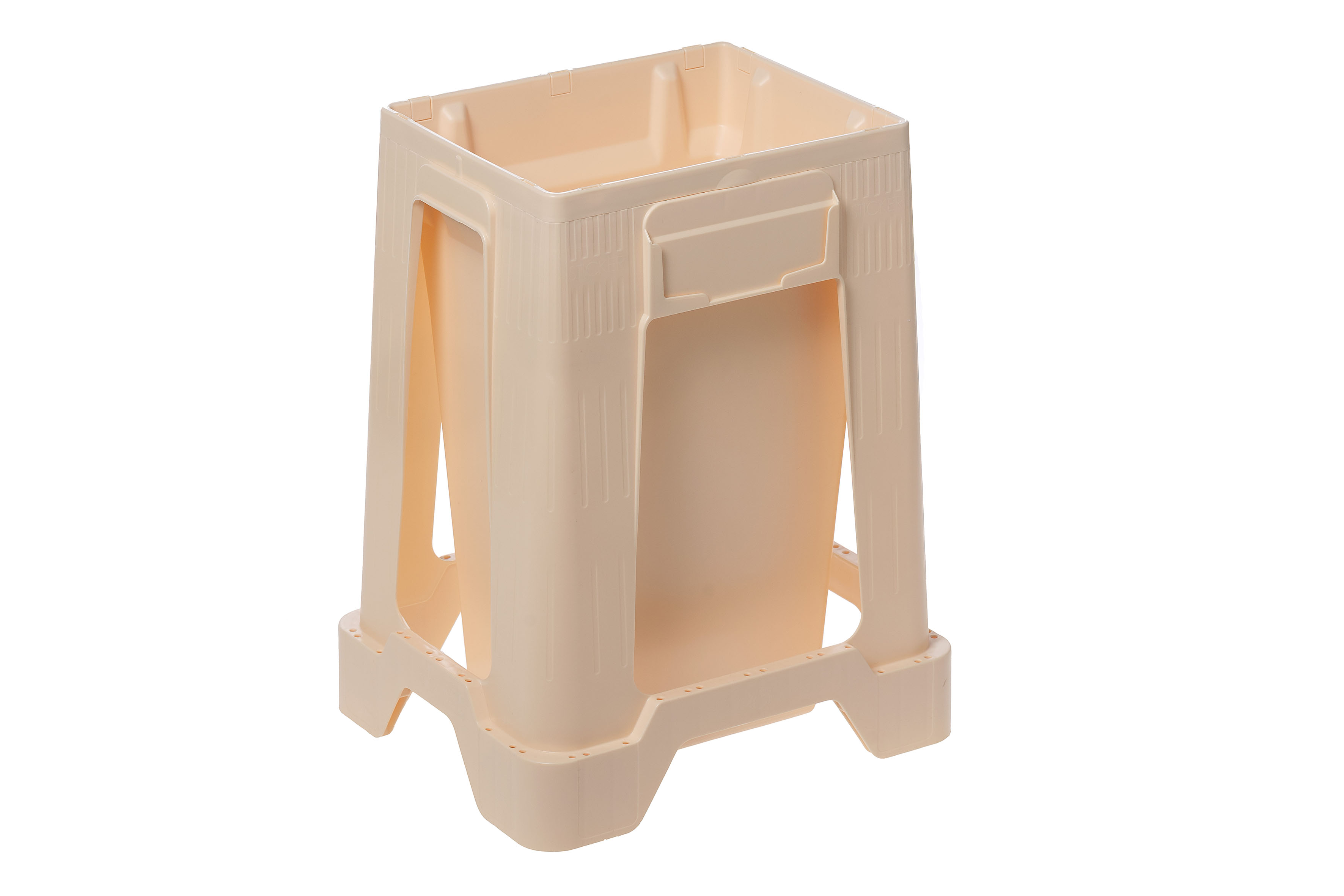
Flower bucket
Fc555

MEMBER SPEAKING

Peter Smak

Smak Tulips BV

"More sustainable alternatives are the most future-proof option."

Peter Smak is the co-owner of Smak Tulips BV. The company is closely involved in a pilot project involving the tulip selection robot. And since last year, Smak Tulips has been using the innovative ULO (Ultra Low Oxygen) technique to keep the gall mite out of the bulbs and planting stock in storage cells.

"For me, entrepreneurship means: always keeping a close eye on the latest developments. Because our market and the world are constantly changing. You always need to be on guard against that. You can't just start a reform yesterday; by then it's too late. In this case, the problem was the gall mite. A huge risk to our crops. What's more, fewer and fewer chemicals are being used. More sustainable alternatives are the most future-proof option. If you're not prepared for that, you'll find yourself with your back against the wall as an entrepreneur.

We have also carried out other experiments involving the gall mite in the past. We started using ULO last year. You need special airtight cells for that. We have two of these cells, which we use for bulbs and planting stock ready for sale. We then had many discussions with other growers and kept up to date with developments in this area. With ULO, it's all about finding the right balance. With this treatment, you first ensure that the oxygen level in the cell falls below 1 per cent. You keep that percentage for 24 hours. The mite will be dead by then, but there will still be eggs. Of course, we want to get rid of them too. We now know that we'll have to repeat the treatment after eight days. On then the cells are, in principle, free of gall mites.

How do you decide to do something like ULO? Well, it's a massive investment. On the other hand, however, the damage caused by gall mites can run into the millions. Then you realise: it's an easy choice. What's more, it's fantastic for the whole sector that tulips will be completely residue-free on the shelves in future."

"Together, you find the best solutions."

Friso van der Kruk is a cultivation specialist at OK Plant. About three years ago, on the advice of company owner Rob Olsthoorn, he got in touch with Corvus Drones. These days, one of those black 'UFO-like devices' flies through part of the greenhouse every day.

"The sooner you find the thrips, the less severe the infection will be. So, being able to react quickly is incredibly important. Until recently, a team of people carried out weekly visual inspections of our 10-hectare crop for thrips. But that is not a sustainable situation: it is labour-intensive, and staff is hard to find and, moreover, expensive. That is why, three years ago, we launched a pilot project using a drone. The drone needs to rule out the possibility of thrips so that we can apply targeted treatment.

The first phase was devoted to research, covering 4.5 hectares. Normally, a drone flies using GPS, but this doesn't work inside the greenhouse because of the steel structure. That's why there's now a QR code in every corner. These codes tell the drone where it is. Unfortunately, we didn't have a single case of thrips that first year. Yes, that's good for the company, but not so good for the research. The drone takes photographs, and those photographs are analysed by AI software. But that software will need to learn what a thrips infestation looks like on our plants. At first, the software regularly flagged thrips when there were none. Perhaps that's not so surprising after all; we have about a hundred different varieties of orchids. One leaf is smooth, whilst another has a pattern or a bump. So that noise had to be removed first.

We are carrying out this research in collaboration with Ter Laak Orchios, Levoplant and Stolk Flora. You can't tackle major developments like this on your own. You need each other to make it work properly. That way, you can share the costs and learn from one another. At the moment, the drone is already working very well: around 85 percent of the thrips detected by the software are actually thrips. Of course, there's still room for improvement – that's what we're currently testing. Once we're completely satisfied, we might well expand the drone's tasks. But first, we are dotting our I’s and crossing our T’s with the current task at hand."

MEMBER SPEAKING

Friso van der Kruk

OK Plant